by

I’m Speaking at the Office 365 Saturday Australia 2015 #o365cbr

I am delighted and humbled to have been confirmed again as a speaker for Office 365 Australia.

This fantastic event is held in most capital cities in Australia throughout the year. At each event there are no less than 10 fantastic sessions covering all aspects of Office 365 presented by respected professionals in various fields.

O365 Saturday Australia

Join administrators, end users, architects, developers, and other professionals that work with Microsoft Technologies for a great day of awesome sessions presented by industry experts.

The Session

My Session is called "eDiscovery and Privacy: All your data are belong to us!"
Abstract: "In the 90s, Legal and IT professionals began compiling computer data and legislation, eDiscovery started its first steps. Back then, nobody would believe email, let alone social media, could be used in court. 20 years later, eDiscovery is here to stay, but is the industry prepared?"

In this session, we will talk about the biggest challenges for eDiscovery and some solutions in the works, with focus on Office 365 technologies."

edge-pereira-office365-saturday-australia-canberra-o365cbr-speaker

When and Where

O365 Saturday will happen in Canberra, Australia on 24th October at Cliftons - 10 Moore Street, Canberra ACT 2601. Registrations start at 8:30am.

Come and join the fun. This is a great opportunity to meet with our community, connect and grow friendships and discuss real life, everyday challenges with likeminded folks.

by

Collab365 Conference Social Media Numbers

We made it! Collab365 was a fantastic event. Truly global, multicultural, multi-time zone, multi-everything.
And I am humbled to have been part of the event sharing knowledge.

During 2 days, across the whole planet, experts on Office 365, SharePoint and Azure bonded in a series of presentations delivered from Europe HQ to the whole world all thanks to the magic of the streaming. At this day and age when everyone mostly (only) talks about the new buzzwords "innovation", "disruption", "internet of things"  the Collab365 team done it and shown it.  I have a few “Thank You” words to the organizers, presenters and attendees. If you this this is a TL;DR kind of text, feel free to skip straight to the nice pictures a bit later in this post. They have the social media data collected.

To the Organizers

You guys are awesome! (I mean, really). From the whole organization with tasks, electronic signatures, forms technology and all that jazz. I don't think people actually understand how big of a deal organizing such a thing is. I don't think I can write enough about how I appreciate your initiative and effort. I wish I could pay you a beer or a cup of coffee or whatever :) you guys and girls did it!

To the Speakers

I mean, we (the presenters) didn't do this for money (I know, I know..I can hear the arguments, but bear with me on this). We do this because we love to share knowledge! I do have a wife and 3 kids and a consulting job that makes me travel a lot, weeks away from home sometimes!! It is hard to find time and put together content, work on demos, test, present, adjust, cut here and there, lots of late nights...all this in the hope that people will find our knowledge useful. I am sure some demos did not go as well as expected, someone must have been sick on the day, the connection was not great, some presentations were longer than expected since we were streaming etc...but the knowledge is there and was shared. I believe that if at the end of the presentation people left knowing something new they didn't know before they started, that's a huge accomplishment. We did it awesome!     

To the Attendees

You guys rocked! all this effort wouldn't mean anything if nobody turned up. We connected at the coolest level, at the intellectual level and with the spirit that 2 + 2 = 5. The sum of our gathering makes something bigger the us. And that is now history, immortal. Be proud of that! If you see any the presenters or organizers online or in person, give them a beer :) It is hard finding the time to put a presso nicely and deliver to the masses. Harder that most people think! Well, some people are naturals at it but I am talking about what I do and what I see out there with other presenters :)

OK, Let’s Talk About the Stats

In the spirit of continuous improvement, I needed to find data about the past to improve the future thus delivering a even better next event. So, at the end of the conference on a Friday night I put the kids to sleep a bit early, prep myself the a cup of coffee and went on to collect data and analyse the numbers of the conference. My criteria used twitter hashtag #collab365 and the event organization handle @colla365 as starting points. No Facebook analysis was done. (Maybe in the next one…) From there a whole bunch of data is collected. Data about geographies, gender were taken from the twitter profiles that had them exposed. Data related to time and date were relative GMT (London). The collection stated 6 hours before the conference started and ended 6 hours after the conference finished. If I tried to collect the same data later tomorrow it is likely to be a bit larger because people might still be posting their sentiment online about the conference and still using the hashtag.

I will come back latter to update the text and stats comments in this post, so feel free to check  back this link from time to time.

Anyway, I won't take much from your time reading my musings here :) Let's go to the numbers.

edge-pereira-collab365-office365-conference-2015-1edge-pereira-collab365-office365-conference-2015-2edge-pereira-collab365-office365-conference-2015-3edge-pereira-collab365-office365-conference-2015-4edge-pereira-collab365-office365-conference-2015-5edge-pereira-collab365-office365-conference-2015-6edge-pereira-collab365-office365-conference-2015-7edge-pereira-collab365-office365-conference-2015-8edge-pereira-collab365-office365-conference-2015-9edge-pereira-collab365-office365-conference-2015-10edge-pereira-collab365-office365-conference-2015-11edge-pereira-collab365-office365-conference-2015-12edge-pereira-collab365-office365-conference-2015-13edge-pereira-collab365-office365-conference-2015-14edge-pereira-collab365-office365-conference-2015-15edge-pereira-collab365-office365-conference-2015-16edge-pereira-collab365-office365-conference-2015-17edge-pereira-collab365-office365-conference-2015-18edge-pereira-collab365-office365-conference-2015-19edge-pereira-collab365-office365-conference-2015-20edge-pereira-collab365-office365-conference-2015-21edge-pereira-collab365-office365-conference-2015-22edge-pereira-collab365-office365-conference-2015-23edge-pereira-collab365-office365-conference-2015-24edge-pereira-collab365-office365-conference-2015-25

by

A Cloud Data Governance Model for Office 365 Delivery

If you have ever been involved in enterprise-wide cloud or collaboration projects (specially using SharePoint) you have heard about governance every second-day. Governance is a big ticket these days to tackle in every serious IT project.

Quickly summarizing, governance is the set all processes of "governing" (as in state governments) the interaction and decision-making steps for a scenario or problem. This set of processes are then normally compiled into a piece of work that outlines how to enforce these rules in the big picture and make sure they are adhered and followed. This is a broad explanation, and because IT is so complex and vast every time someone talks about governance, it is always followed by an area and never a single-monolithic set of rules. That's why we hear about: SharePoint Governance, Cloud Access Governance and so on.

Anyway, today we will talk about cloud data governance. The need this has always been a recurring theme when we talk about data protection and compliance. With Office 365 it wouldn't be different.

Cloud data governance is important because without it, any data protection strategy you want to apply to our Office 365 enterprise compliance will be like a silo, isolated.

For starters, let's try to get a generic picture of data governance and break it down to a bit more specialized areas.

Please bear with me and allow me to start a very simple and generic Cloud Data Governance model which can be used for a classic Office 365 collaboration project. One that can be easily categorized in: Foundations and Leadership.

edge-pereira-office-365-cloud-data-governance-model

Leadership is About Structure

Leadership is about structure and the programs that drive the governance enforcement. Executive powers in this category covers what organizational management tasks are required to make sure an ongoing commitment is established and cascaded down to the peers. Data Stewards and Custodians make sure that the RACI matrix is cleared, covering the roles and responsibilities of every individual affected directly or indirectly by the governance plan is addresses.

Foundation is About Initiatives

Foundation is about initiatives that as a whole covers the basics on the compliance, authorities and risk management.

Thinks like business continuity (including disaster recovery) addresses the risk management responsibilities. When events happen which causes the data to change during its lifecycle, the information lifecycle management kicks in, making sure these audit trails are aligned with your data protection rules.
Under the foundational stones, we also can include data architecture addressing master data management; Retention management to make sure analysis tolls are fully functional and addressing data requirements updates for keeping and trashing of data; Data quality to make sure the data is healthy and in perfect quality for its usage; and as expected, Security which in our cloud case addresses data classification and confidentiality. Security can't cover much more than this because, remember we are talking about Microsoft cloud infrastructure, and most of the other aspects are taken care of by the Microsoft security team. There is only so much further we can go on it.

This graph is a quick illustration of what an average cloud data governance looks like from a helicopter view. It does not mean that it covers everything your organization needs. Likewise, it also does not mean that every single data governance control needs to be associated with data protection. The main goal here is not achieve 100% of security (which is in itself, quite a task if you ask me) but instead to minimize the gaps and the surface for attacks and breaches.

The broader you start with your cloud data governance picture the better it is, because it will be like a beacon providing guidance for big and small pieces of projects going on. And at the end of the day, project teams want to have something to aim for. The governance strategy is not static, it adapts to the needs and if something is missing, generally there is no issue, just address it in the strategy and make sure the communication plan is in place for it.

by

Who Owns My Data Stored on Office 365 ?

OK, so by now you have know that decided to keep your emails, photos, documents in the cloud (using Google, Microsoft, Yahoo, Amazon etc) and talking with people, one question that I get very often is "Hey, since I am keeping my files in the cloud stored in these companies machines, do they own my data now? Can they read my emails?"

edge-pereira-office-365-who-owns-the-data-1

I am going to address here the Microsoft point of view. Short answer: No, you still are the owner of the data. Even if they are stored in their servers.

Of course, Microsoft has a very comprehensive process to access the data stored, after all that information stored in the cloud needs to be looked after (backups, storage, etc). There is very, very, very little possibility for someone alone get their hands in your information.

For example, when you open your email or when you see a photo from your online album stored in the cloud, there is a huge amount of processing, exchange and compiling happening behind the scenes to grab your data which is spread in many locations and make it to your computer screen magically as if it was stored in your computer's local drive. If someone had access to the actual physical server where these emails or pictures are stored, it would be virtually impossible (just to not to say 100% impossible) to retrieve that same information.

That's because there is a very complicated and secure process for this to happen and the reason this process exists is to address privacy, regulations and compliance concerns of several institutions and governments. Remember: Just like regular users, Microsoft also has big organizations and even governments as clients and they store data there too.

About Data Visibility and Control

Now, let's talk about what happens when someone first moves their data to the cloud. When this happens, a key tenet of ownership is the visibility level and control that person has over their data. They are basically compost of 3 things: Being able to see the data, being able to perform actions on the data, being aware of what actions were performed on the data at any given time.

edge-pereira-office-365-who-owns-the-data-2

And despite these seems to be 'simple things', they are extremely complex to achieve. Nevertheless they are achieved to the perfection by the cloud team. Quite frankly, chances are your data is several times more secure in the cloud than it is in your local computer or hard disk. Want to test that theory, just ask around how many people use any encryption in their computers, mobiles, USB drives? This is a very basic test that many of us don't pass. Another one, if your computer or external disk crashes, would you recover ALL your data in less than 1 hour?

As you can see, the challenge here is because it is on you/us to define and implement consistent configuration with appropriate data access and process and distribution and backups across all your environments. This is a costly process (would you have a separate laptop 100% synchronized with your current laptop just in case it crashes?) and usually requires specialist knowledge for administration. In Microsoft Office 365, that is all baked into the service for you.

Not to mention archiving is built directly into the cloud, so you can take actions like preservation, deletion, auditing, and data loss prevention, and perform search based on who uploaded the data, who modified the data, date range, keyword etc.

To be able to viewing and perform actions on the data are extremely privileged operations and in the Microsoft cloud there are defined roles defined for a specific set of people. If you're not satisfied with it, the scope and reach of these roles can be defined the customer itself (after all, they own the data).

Feel free to share your experience with storing data in the Microsoft cloud or Office 365, or any other cloud provider company for that matter.

by

I’ll be Speaking at the 2015 Collab365 Conference

I am super excited to be selected as speaker at the Collab365 Conference. The largest Office 365, Azure and SharePoint event of 2015.

edge-pereira-office365-collab365-event-mvp

It will be 24 Hours of Office365, SharePoint, Azure and more!! This is the event for 2015 if you want to gain in depth insights from experts all over the globe. Whether its the technology that you want to learn about, the applications or the implications of using Office365, SharePoint or Azure, this is the place where you will find answers. Our speakers will bring their lessons flavoured with unique local perspectives directly to your device.

We are 62 MVP's. 6 MCM's. Microsoft Product Managers and experts. The level of submission to the event was staggering.

Collab365-office365-edge-pereira-speakers

Starting on October 7th 2015. Following the sun for 24 hours, the COLLAB365 "Global Conference" is THE virtual conference if you want insight into Office365, SharePoint, Azure and more! Register now to be one of an expected 10,000 delegates.

Have a look at the great line up of speakers, sessions and register to not only participate of this massive event but also win prizes!

And as for my session…you know what to expect Winking smile

edge-pereira-collab365-office365-dlp

Win, Win, Win for everyone!

See you there.

by

Public Speaking Presentations Edge Pereira

I do speak quite often and generally I try to make them as fun and entertaining as possible. If you’ve been to one of my sessions, you know what I am talking about Smile

edge-pereira


Here are some of the presentations I’ve done so far…

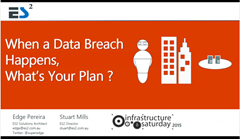
imageSession: When a Data Breach Happens, What is Your Plan?

Event: Infrastructure Australia 2015


imageSession: Office 365 Data Leakage Protection, Privacy

Event: SharePoint Paris 2015


Event: Office 365 Australia 2015 – Canberra


Event: Collab 365


Event: Office 365 Australia 2015 – Brisbane


Event: Office 365 User Group Australia


Event: TechEd Australia 2014 - Sydney


imageSession: Regulatory Compliance and Microsoft Office 365
Event: TechEd Australia 2014 – Melbourne


Event: Infrastructure Saturday Brisbane 2014
by

The Age of the Digital Workplace and Office 365

“Today’s workplace is challenging. Motivated by their own digital experiences at home, workers now desire the same in the workplace. In this session we will demonstrate how Office 365 can harness the power of digital to provide workers an engaging and empowering experience, using Skype, real-time collaboration with OneNote, Yammer, groups all these from their own devices ultimately driving a transformational business change for the better.”

Thank you everyone who came to my session at the Australian Office 365 Saturday conference. It was an absolute honour to share and learn with you. Feel free to reach out. Let’s continue the conversation.

Here are the slides!


by

SharePoint 2016, Hybrid Search and Data Loss Prevention

SharePoint Server 2016 IT Preview is now available for general download.

SharePoint-2016
    
Today SharePoint Server 2016 IT Preview was announced by Microsoft. A Preview version is not the full-blown product but it is an early enough version for the people on the field to inspect and start getting their hands-on with the new technology, which by the way is great. Big shout out for the SharePoint team for doing these things.

The download is about 2.8 GB and you can get it here. There are language packs for Spanish and Japanese as additional downloads.

edge-pereira-sharepoint-2016-download-dlp

Let's cut to the chase.

What's new?

DLP and Compliance

Data loss prevention is paramount in todays business and if you have been following me, this must be enforced across the board wherever is possible. SharePoint 2010 offers controls to minimize the content exposure that might lead to legal and compliance challenges. SharePoint 2016 have several controls to make sure sensitive information types are handled properly and at the same time ensuring right people have the right access level to the information at the right time.
Some of these new controls are In-Place Holds and Document Deletion centres. They will extend on the current eDiscovery capabilities covering from SharePoint living content up OneDrive for Business content and allowing rules such as deleting content after an specified expiration time.

Something that will affect data protection with SharePoint 2016 is Search Technologies. Search in the cloud is becoming a centrepiece in the data protection strategy. With the advent of the Hybrid Search, the index content will be stored in the cloud which needs to be considered when mapping the data sovereignty plans. So, make sure your tenant is aligned with the regulations and laws of the location. You might now want to get caught with your SharePoint content living in Australia but the Search Index living in another country, for example. We will talk a bit more about this later.

SharePoint 2016 was designed with cloud, mobile and Infrastructure as a Service (IaaS) in mind. Also, 2016 is the first version that's being built sharing the same core platform from SharePoint Online, so SharePoint 2016 when installed will be very similar to a SharePoint Online deployment.

Installation and Deployment

This new version reduced dramatically the deployment and management of SharePoint together with cloud components. A lot of the administrative tasks are streamline, just like SharePoint Online.
Also, just like Windows Server 2012, installation can be performed by roles so you don't need a full blown deployment for every server, only the required bits for that server role in the whole infrastructure.

Mobile Devices and Touch-friendly

SharePoint 2016 incorporates the latest standards to integrate with mobile push-notifications and synchronization. HTML5 is king in the new SharePoint with all the cool beans to make sure SharePoint apps are better targeted and content are to mobile devices. Also by using an unified HTML5 views people can have the same experience anywhere they are accessing it: cell phone, tabled, desktop etc.

App Launcher

The app laucher, a loved feature from SharePoint Online, now is part of SharePoint 2016. It is a global place where people can quickly launch applications, sites and files.

Document Libraries
Another feature coming from SharePoint Online are the new controls for files and contents. The whole experience of creating, sharing and collaborating on files and content now is the same as SPO.

Sharing

Now every page in SharePoint 2016 have a Share button. No more navigating to ellipsis or other properties. Just one-click, give the name of the people you want to share with and go. Similar to SharePoint Online, the invitees will get a link to access the content. This process also eliminates the need to check the security matrix, making the sharing experience much easier to understand.

Large Files

SharePoint 2016 now offers support for uploading files up to 10GB.

One More Thing Before You Go

Hybrid search is here. Hybrid search and its improvements are not really part of the SharePoint 2016 package, however today Microsoft announced the Cloud Hybrid Search preview, which is a product that extends the search capabilities from SharePoint 2013 and SharePoint Online to return search results in an unified location. The central point for the search index is Office 365, which makes it a great extensibility window for integration with more products. SharePoint 2016 has this integration point already baked into the product.

Because the search index for a Cloud Hybrid Search will be residing in the Office 365 cloud it will offer the users the ability to discover related information across on-premises and cloud content. Keep in mind that for this to happen *ALL* crawled content will live in the geography tenant, including your on-premises content.

Here's the link to download Cloud Hybrid Search. Give it a try and see how this can affect your business scenarios.

You can read more about this announcement here.

The upcoming months are likely to be *very* busy for us all working up the new SharePoint puzzle . And that's great!

by

Office 365 DLP protection cool again

Thank you everyone who came to see me talking about Office 365 DLP, Privacy, Data Leakage Protection. Office 365 User group at Microsoft Brisbane offices.

I love doing these things for the community! Feel free to reach out if you need anything or want to talk more about it.

by

BYOD Guidelines and Office 365 DLP


Let's talk about "Bring Your Own Device"(BYOD) again. We all know how often people have devices which are more capable than what their current organizations/employers offer. Rightly so, to keep all devices and all systems updated across the enterprise it is still a huge, and expensive, task. BYOD has a security framework that allows the regular folks to being their own laptops or mobiles to use at work.

The issue starts when company data is exposed in a risky way. Would your manager be OK with you having an spreadsheet with people's contacts details, addresses and sometimes financial values? hint: the answer should be NO; otherwise you guys needs to have the "data protection talk" :)

The key here to make sure the risks do not outweight the benefits of BYOD is to make sure reasonable steps were taken to mitigate data leakage and exposure to the wild web.

office-365-byod-guide

And that brings us to the point I wanted to discuss. Canada is one of the first nations to move in this direction with a comprehensive set of guidelines for mitigation polices. More precisely, the Office of the Privacy Commissioner of Canada released a guide (Is a Bring Your Own Device (BYOD) Program the Right Choice for Your Organization?) highlighting several key privacy and security risks that you and your organization should take into consideration for a BYOD program.

This is a Canadian perspective but some of the points are excellent for your own discussions. It is a long document but if we can summarize the main points they recommend are...

office-365-byod-guide-2

Perform an Impact and Threat Risk Assessment

Privacy Impact Assessment (PIA) and a Threat Risk Assessment (TRA) needs to be done to identify and address risks associated with the acquisition, handling, storage and period retention of personal identifiable information (PII). If you've been to any of my presentations, you see how much focus and stress I put on the demos with personal data. They are extremely valuable and can do real damage to everyone involved, people and companies.

Create specific BYOD policies

Dedicated BYOD policies needs to be developed, consolidates and established for all devices covered in the program. Training here is essential. All users part of the BYOD program must have a clear set of expectations about what they can and can't do with their devices, including training on privacy protection and defensive data handling (to mitigate security threats). The guide recommends for CTO offices engage directly with other departments. The objective here is to develop enforceable, easy-to-communicate BYOD policies. There is no point in having a hard to follow/hard to understand framework across the board. In short they should address at a minimum: user responsibilities, acceptable uses of BYOD devices, application management and access requests.

Containerization

Containerization means group and isolate corporate data that might be living offline in an employee's device. The goal here is to create a division between personal data (for example, family pictures in your mobile) and company data (for example, sales forecast documents, resumes etc).

Incident Management

Let's face it, doesn't matter how much effort and controls we put around a technology, at some point the data will likely be compromised. The question here is: What to do when this happens? Technology is a living thing. In 5 years from now, the technology landscape will be totally different from when we have today. So, when a a privacy or security breach happens, an mature and well-thought out incident management process needs to be in place. The goals here are to identify the root cause, report, analyse and correct the breach in a timely fashion...and then use the learnt lessons for the future.

Inventory

As part of the incident management, the guide recommends that companies should create an inventory of the connected devices. The goal here is to take appropriate steps during an incident response. Users must understand that personal devices which are not adequately secured might expose company information to malicious elements and this often leads to financial loss (for losing competitive advantage, reputation damage etc).

All these are great points and at first they seems very obvious. Tricky part here is that the obvious is hard to implement.

BYOD Program Seems Too Complex for Our Company

If you are reading this and think that your organization can't have a BYOD program because these guidelines might be too hard to implement, don't worry there are still steps you can do to make sure you meet them halfway. More and more the workforce is digital and users are demanding these programs. My 2 cents here is that the organization should aim to have a secure enough environment where the benefits of a smaller BYOD program can be leveraged. The main thing in any security program is still the same: User education. We are becoming so technologically connected, with machines so auto-sufficient yet the main component always was, still is (still will be?) people.

If you found this interesting, let me know what you think in the comments.

by

New Yammer Office 365 Features

If you're a current user of Yammer, you will be pleased to hear the great news Yammer team have done for you.
If you're not, I recommend for you to give it a try. In short, Yammer is like a "Facebook" for the enterprise.

edge-pereira-yammer-sample

It was acquired by Microsoft and soon later incorporated under the Office 365 umbrella.

It's great integration with document authoring tools and a very intuitive and responsive design are the coolest features of the product. This month, Microsoft made some announcements for the product that aim to raise its profile and increase adoption by the users across the board.

edge-pereira-yammer-sample-2

Immersive Experience

Files now can be previewed and edited straight out of Yammer. A unobtrusive window will appear on top of your browser session with the Office Online tool required to edit your document and then saved directly to the cloud. Changes made in the file are appropriately tracked with out-of-the-box versioning.
External Collaborators

Another cool feature from Yammer is the ability to share document with people outside your organization, if needed. Now Microsoft is taking this to the next step: External people can collaborate on the document together with your team is needed. This is not a paid feature, this is now available to everyone using Yammer.

Real-Time Co-Authoring

Document preview in Office Online is already available as of today. Real-Time Co-Authoring is in the roadmap for early 2016.

If you use Yammer, feel free to engage in the conversation in the comments. If not, what are you waiting for? :) join the fun. You can even create a Yammer network for your own family members, for example. Like your own family Facebook!